


Home
»Blog Insights
»How to Build an AI Influencer Platform in 2026: The Next Frontier for Brands, Creators, and Digital Product Teams
How to Build an AI Influencer Platform in 2026: The Next Frontier for Brands, Creators, and Digital Product Teams
Keyur Patel
June 2, 2026
13 min
Last Modified:
June 3, 2026
Hyundai needed to introduce the Kona to the Moroccan market. Rather than going through the usual process of casting and briefing a human influencer, they partnered with Pixel.ai to deploy Kenza Layli across YouTube, social content, and a live customer chatbot. Kenza is a Moroccan AI persona developed by Meriam Bessa at Phoenix AI, a Casablanca-based agency. She was culturally grounded, multilingual, and entirely synthetic.
According to Marketing Week, citing Pixel.ai, she operated across eight languages and handled more than 2,000 customer conversations simultaneously. The campaign was reported as the most successful influencer-led product launch in Hyundai’s history, with Pixel.ai citing a 20x return on investment.
However, handling such a huge number of conversations through a single persona is not just a content generation challenge. The visuals, the voice, and the cultural specificity are the visible parts of the system. The harder part is maintaining consistency across every interaction while the persona operates at real campaign scale.
That is where most teams discover the gap between a convincing prototype and a production-ready platform. Keeping an AI persona coherent across live conversations, content pipelines, multiple channels, and unpredictable user interactions is fundamentally an infrastructure problem, not just a creative one.
AI influencer marketing tends to get framed as a creative challenge. You need a persona with a distinct voice, a recognisable face, a content strategy. That part feels familiar because it maps onto things most founders have navigated before.
What does not feel familiar is what sits underneath all of that. The system that keeps the persona coherent six months in. The layer that allows her to handle an unscripted customer question without going off-brand. The pipeline that keeps content moving at full campaign volume without constant manual intervention.
That is where the real distance between a promising prototype and a product that actually works lives. And it is the part that does not get enough honest conversation before teams find out the hard way.
Who Is Actually Building This
After a story like Hyundai’s, the natural question is whether this is something available to teams without an enterprise budget and a dedicated agency relationship. The honest answer is yes, but the use cases look different, and understanding which one fits your situation matters before you decide how to approach your own AI persona product development.
Some founders are solving a product education problem. A health tech company with a complex offering needs to reach users across several markets consistently. Producing human-led video content in multiple languages is expensive, slow to update when the product evolves, and hard to maintain at the frequency modern audiences expect.
An AI persona built on a stable character foundation can cover every market, answer follow-up questions through an integrated chatbot, and be updated quickly when the messaging needs to shift.
Others are building brand presence without putting a human face on it. A B2B software company wants a recognisable, consistent voice across LinkedIn and YouTube but does not have a founder who wants that kind of public visibility. They create a named persona, give her a genuine point of view on the industry, and treat her as a long-term owned media asset.
The persona posts regularly, engages with comments, and stays tonally consistent across the entire content history. And some teams are using the persona as a mid-funnel engagement layer.
An enterprise software company places an AI persona between their sales team and the leads who are not yet ready for a direct conversation. She follows up after product demos with personalised video messages, handles common objections through a chat interface, and flags conversations to a human rep when they reach a certain level of specificity. The sales team spends its time where it is most effective. The persona handles everything upstream.
What connects all three of these is that the persona is not a one-off campaign asset. It is something the company operates continuously, something that accumulates value over time. When you build an AI influencer platform with that intention from the start, the architecture decisions you make early look very different from those made for a single campaign.
What the AI Influencer Tech Stack Actually Looks Like
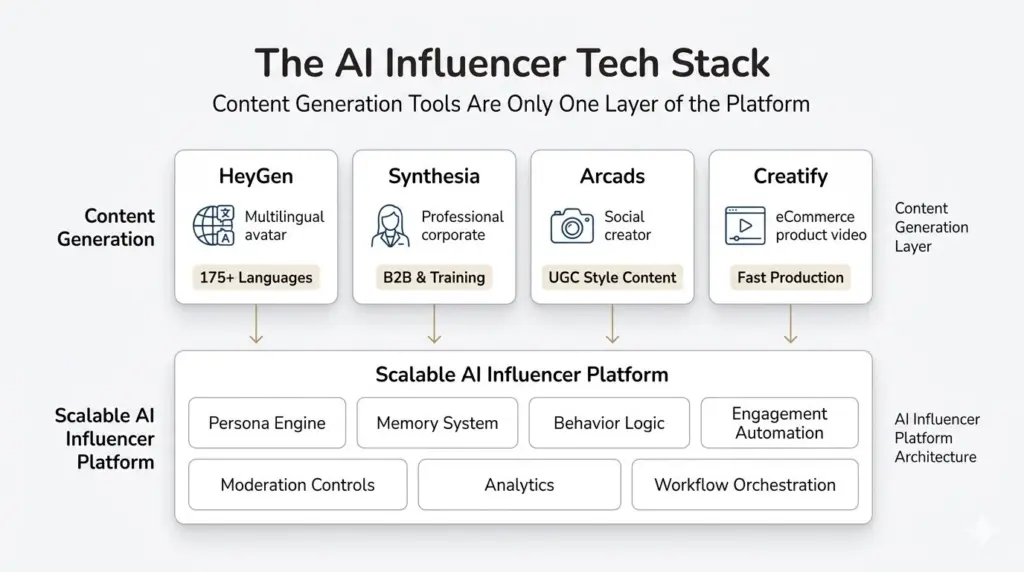
Once the use case is clear, most founders want to understand what they are building with. The AI influencer tech stack at the content generation layer currently has four tools worth knowing well. Not because any of them is the complete answer, but because the choice you make here shapes what is possible at every layer above it. If you want a thorough side-by-side before committing to a direction, a detailed agentic AI development tools comparison can be a great helping hand in the decision making process.
HeyGen
HeyGen is where most teams start when multilingual video output is a core requirement. Support for over 175 languages with accurate lip sync is the headline capability, and it holds up well in practice. Avatar quality is high. The limitation that users report consistently is render speed at volume.
If your content plan involves daily posting across multiple platforms, that throughput constraint needs to be factored into how the content queue is designed, not treated as something that will resolve on its own. The credit-based pricing model also means costs scale faster than the monthly plan price implies, particularly for teams working with Avatar IV quality video at scale.
Creator plan starts at $29/month.
Synthesia
Synthesia suits teams where the use case sits closer to B2B than social-first. The editing environment is structured, the compliance posture is strong with SOC 2 Type II certification, and the overall workflow is built around team collaboration. The avatars are polished and carry a professional quality that works well in corporate contexts.
Where Synthesia falls short is in social environments where the persona needs to feel warm and unscripted. It was designed for internal communications and training, and that origin shows when you try to use it for a persona that needs to feel genuinely human on Instagram or TikTok.
Starter plan at $14/month, with production volume limits that become relevant quickly.
Arcads
Arcads is built for a specific kind of output: informal, direct-to-camera video that looks like something a real creator filmed casually. The ability to control emotion and delivery through text prompts is a genuine differentiator and works better than most people expect.
The gaps are in language coverage, pipeline automation, and content management at scale. For social ad creative and short-form campaign work it performs well. For AI persona product development that needs to sustain consistent output over months, it is not the right foundation.
Starts at $110/month.
Creatify
Creatify is built for speed from product to finished video. E-commerce and performance marketing teams who need high output volume will find the automation genuinely useful.
The limitation is scope: it is a creative production tool, not a persona platform. Generating content fast is what it does. Maintaining a coherent character across a year of output is not what it was designed for.
At $33/month it is the lowest barrier entry point for teams wanting to test AI video before committing to a larger infrastructure decision.
The important thing to understand about all four platforms is that none of them represents a complete solution when you set out to build an AI influencer platform. They primarily handle content generation and production workflows, which is only one layer of the overall system.
The real complexity begins when you need that influencer to behave consistently across campaigns, platforms, conversations, and audience interactions over time. The persona engine, memory framework, behavioral logic, engagement systems, moderation controls, analytics orchestration, and automation pipelines all sit outside these tools and need to be engineered separately.
That is why successful teams treat these platforms as components within a much larger virtual influencer architecture rather than as standalone products. The long-term scalability of an AI influencer platform depends far more on the surrounding infrastructure and orchestration layer than on the content generation tool itself.
Where It Breaks and What That Looks Like
Most teams do not encounter one catastrophic failure. They encounter three quieter ones, each arriving in a different sprint, each harder to diagnose than it should be because none of them announces itself as an engineering problem from the start.
- The persona starts drifting and nobody catches it straight away.
Week one feels strong. The outputs are consistent, the tone matches the character brief, and the team starts trusting the system faster than they expected. By week three, someone on the team notices a post that feels slightly off. The tone is close but not quite right. A comment response uses phrasing that does not match the character brief. By week five, reviewing every piece of output before it goes live has quietly become part of the workflow and nobody is certain when that started.
Persona drift is what happens when the system responsible for holding character consistency does not have the right foundation underneath it. It is gradual, hard to attribute to a single cause, and almost always traces back to the content pipeline being built before the persona engine was stable. This is the same pattern we covered in our piece on agentic development architecture mistakes, playing out at the persona layer instead of the codebase level.
- The content queue falls behind at the worst possible moment.
The demo ran without issues. The early weeks ran without issues. But once the posting schedule is real, the platforms are three instead of one, and the volume matches what was planned rather than what was tested, the render queue starts lagging. Posts miss their windows, approvals begin stacking up, and the workflow that once felt manageable starts falling behind in real conditions.
The frustrating part is that the issue usually is not the creative direction or the campaign itself. It is a virtual influencer architecture decision that worked during testing but started breaking once real production demands kicked in.
- The live layer breaks in front of an audience.
By this stage, the earlier problems have usually started compounding. The persona already needs more manual review than expected. The content pipeline is already struggling to keep pace consistently. Then a live moment arrives: a product launch comment thread, an active chatbot session, or a DM exchange that goes longer than expected.
The content side of the persona still appears stable. The posts are on-brand, the visuals are strong, and the publishing cadence mostly holds together. But live interaction introduces a different kind of pressure. Something fails. The persona gives a response that contradicts her established position. She handles an edge case in a way that reads as obviously automated.
Content generation and live conversation are different engineering problems that need different solutions. Building one well does not transfer to the other, and teams that assume it will tend to find out during a moment they cannot afford.
This is not unique to AI persona product development. It is a known failure pattern in agentic AI development, and more broadly in systems that perform well under controlled conditions surface their architectural weaknesses the moment real-world conditions apply pressure.
The Build Sequence That Actually Works
This is not a checklist. It is a reframe on the order of operations, because that is where most of the avoidable delays originate.
The teams that successfully build an AI influencer platform without burning sprints on preventable problems are not moving through more steps than everyone else. They are moving through the right steps in the right order. The persona engine, the foundation that holds character stable across all outputs, gets built and stabilised before the content pipeline is touched.
The content pipeline gets stress-tested at real production volume before the live conversation layer is introduced. Nothing in that sequence gets treated as something that can be bolted on later without cost.
When you are under timeline pressure and the prototype is performing well and the team is confident, the pull toward building everything in parallel is strong. That instinct tends to produce the exact failure modes described above. Not because the team is doing anything wrong, but because shortcuts in build sequencing create compounding problems that only become visible at scale.
The same principle applies across agentic AI development, the decisions made in the first few sprints determine how much of the later work is building forward versus fixing what was built too fast.
The AI influencer tech stack you choose matters. The virtual influencer architecture you design on top of it matters more. But the thing that determines whether either of those holds up in production is the judgment behind the sequencing decisions. That judgment is genuinely hard to shortcut, and it is the part that benefits most from someone who has been through this specific build before.
Our agentic codebase engineering checklist is a useful starting point if you want to pressure-test your current approach before the next sprint. And if you want to see what the right sequencing looks like in practice, the Antigravity codebase embed is a clear example of how upfront architecture decisions directly determine build speed downstream.
Why Starting Now Still Matters
There is a compounding dynamic to AI persona product development that does not get discussed enough. A persona with six months of consistent posting history, an established audience, and a content archive that reflects a coherent point of view is worth considerably more than a persona launched from scratch at that same future date. Not because the tools available then will be inferior, but because the audience relationship and content history cannot be reconstructed after the fact. That equity accumulates in real time or not at all.
The founders who are treating their decision to build an AI influencer platform as a long-term infrastructure investment rather than a campaign-by-campaign commitment are the ones building something that gets more valuable the longer it runs. The window is not closing overnight. But it is open now, and the advantage of starting with a solid foundation rather than rebuilding one later is not a small one.
The question worth sitting with is not whether to build. It is whether the foundation you are building on now is the kind that compounds or the kind that needs to be replaced before it can scale.
Before Your Next Sprint
If your build keeps surfacing the same problems, the persona losing consistency, the content pipeline struggling to scale, the engagement layer behaving differently from the rest of the product, those are usually signs that the platform needs a stronger foundation behind the experience.
The challenge with building AI influencer platforms in 2026 is not just generating content. It is building systems that can maintain personality, adapt across channels, support rapid experimentation, and still feel cohesive as the product evolves.
Whether the goal is creating a virtual creator, testing AI-led campaigns, or launching a scalable creator platform, the teams that move fastest are usually the ones building with flexibility in mind from day one. If you are exploring what that process could look like for your product, our vibe coding development services team can help you evaluate the right direction before the complexity starts slowing things down.

Keyur Patel
Co-Founder
Keyur Patel is the director at IT Path Solutions, where he helps businesses develop scalable applications. With his extensive experience and visionary approach, he leads the team to create futuristic solutions. Keyur Patel has exceptional leadership skills and technical expertise in Node.js, .Net, React.js, AI/ML, and PHP frameworks. His dedication to driving digital transformation makes him an invaluable asset to the company.
Related Blog Posts

Supabase Row Level Security: Everything You Need to Know

Supabase Free Tier Limits: What Actually You Need to Know in 2026
