Custom Software vs Off-the-Shelf Solutions: Which Is Right for Your Business?
Keyur Patel
February 26, 2026
7 min
Last Modified:
June 3, 2026
When organizations begin their growth journey, software decisions are usually driven by speed, affordability, and immediate functionality. Teams identify a business requirement, evaluate available tools, and implement solutions that can quickly solve operational challenges. At this stage, convenience often matters more than long-term scalability or architectural flexibility.
As businesses expand, however, software starts playing a much larger role in operational efficiency, collaboration, and scalability. Systems begin influencing how departments share data, automate workflows, and manage growth. What once appeared to be a simple solution gradually becomes a critical business dependency.
This is where companies begin reassessing whether their existing technology truly aligns with their processes and long-term goals. Instead of focusing only on features, businesses start asking a more strategic question: should they continue adapting their workflows around off the shelf software, or invest in custom-built solutions designed specifically for their operations?
The answer to this question can significantly impact scalability, flexibility, integration capabilities, and long-term business growth. In this blog, we will explore the key differences between custom software and off the shelf software, along with the advantages, limitations, and factors businesses should evaluate before making the right technology decision.
What is offered by the Off-the-Shelf Software
Off‑the‑shelf software supports standard business operations across industries. Its design follows widely accepted workflows, enabling fast implementation and consistent pricing.
Organizations benefit from several advantages:
- Quick implementation cycles
- Lower initial capital investment
- Ongoing vendor-managed updates
- Established reliability through large user bases
For companies operating within standardized structures, these systems offer practical value. When processes follow familiar patterns and technology does not define competitive differentiation, ready-made solutions provide efficiency without additional complexity.
However, over time, standard software shows its limits. Some surface‑level tweaks are allowed, but the underlying system is locked. The personalisation of Dashboards can be done, but the core behaviour remains unchanged.
These limitations become more pronounced as the operational complexity increases.
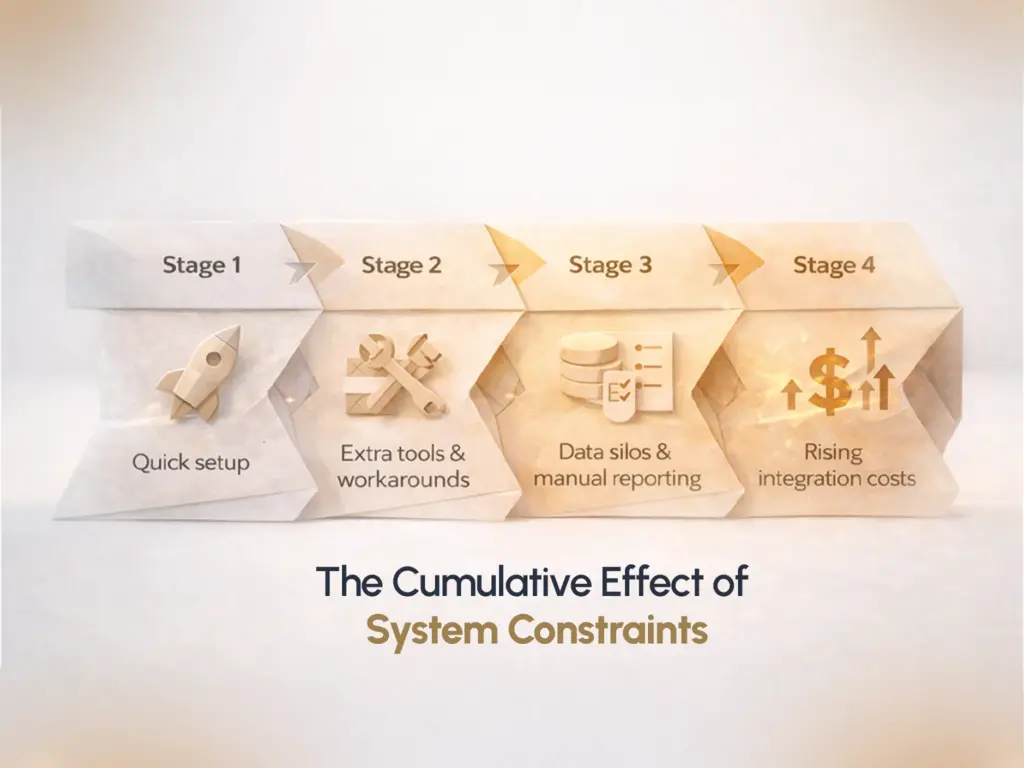
The Cumulative Effect of System Constraints
Early-stage compromises rarely appear significant. Teams export data when reports do not align. Operations maintain supplementary spreadsheets to compensate for missing functionality. These platforms connect disconnected systems and help them communicate.
Individually, these tweaks feel manageable. But when combined, they start causing problems.
Data becomes scattered across multiple platforms without consistent oversight. Reporting turns into a manual task, automation is restricted by complex integrations, and expenses grow as additional tools are added to cover missing features.
The organization continues functioning, but efficiency gradually declines. Leadership may not observe immediate disruption, yet structural drag becomes measurable.
At this stage, many organizations begin exploring custom software development services not as an upgrade, but as a strategic correction.
How Custom Software Development Reorients the Process
Custom software development focuses on business analysis before any product decisions. It doesn’t force processes into predefined models; it begins by examining the organization’s real workflows.
A professional software development company looks at workflows, approvals, data architecture, compliance, and future plans. This detailed study ensures the software matches the business structure.
Well-executed software development services enable organizations to consolidate fragmented processes into a unified framework. Integration is designed intentionally, not retrofitted. Automation occurs at meaningful decision points. Data flows support consistent reporting across departments.
Custom software still contains complexity, but it manages it more cleanly, reducing dependence on temporary fixes and third‑party integrations.
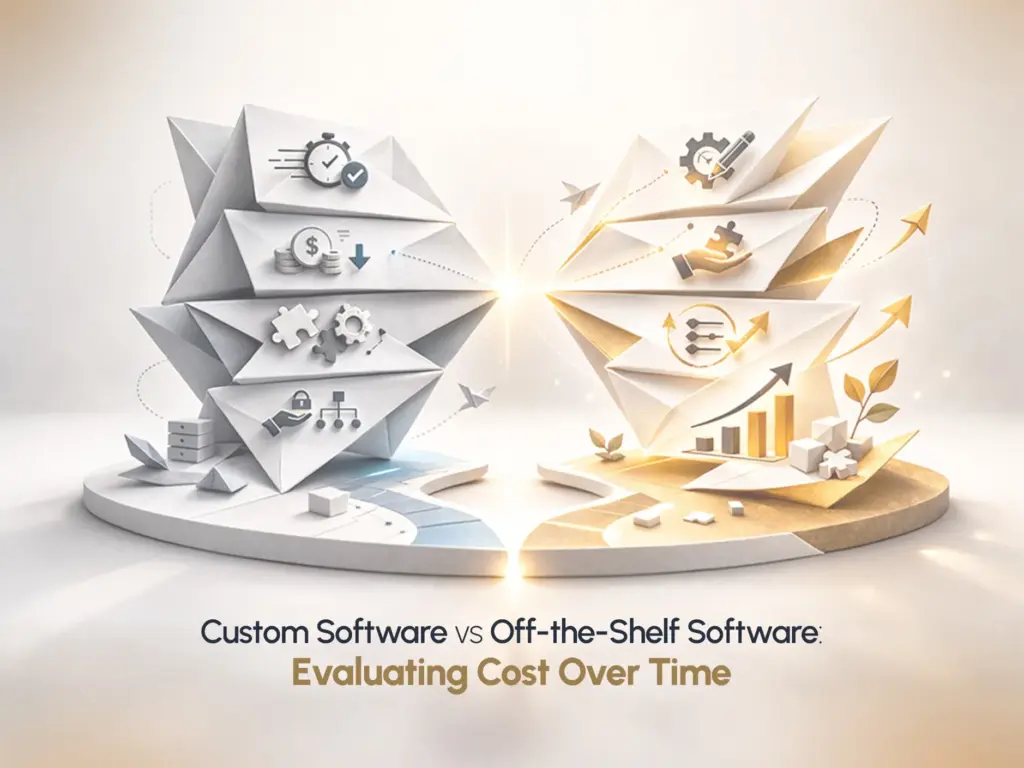
Custom Software vs Off‑the‑Shelf Software: Evaluating Cost Over Time
Initial pricing often drives early choices. With subscription‑based pricing, off‑the‑shelf software makes it easier for businesses to access strong features without heavy upfront investment.
However, subscriptions are only part of the long‑term cost. When the number of users grows, the overall price rises. To access advanced features, the upgradation or buying the extra modules may be needed. Also, integration tools bring extra charges, and migration becomes pricey if the system hits its limits.
While custom software requires a higher initial investment due to its structured development process, it often lowers long‑term vendor dependency and ongoing integration effort.
A meaningful comparison looks at multi‑year costs, not just the upfront expense.
Control and Roadmap Ownership
Another significant difference between Custom Software vs Off-the-Shelf Software lies in strategic control.
For packaged software, vendors set the direction of the product. Businesses have to work within those external plans and rules. When the vendor focuses on other priorities, the updates might not fit the organization’s needs.
With custom platforms, organizations decide the direction of the system. They set their:
- Own priorities
- Match security to industry standards
- Ensure the software develops in line with their goals instead of vendor updates
For businesses dealing with sensitive data or heavy compliance requirements, having this control improves long‑term reliability.
Connecting Systems in a Complex Digital Environment
Today’s businesses rely on several integrated systems across CRM, finance, HR, analytics, and customer‑facing platforms. Their efficiency depends on effective data exchange between them.
Off‑the‑shelf platforms use standardized APIs for integration. They handle typical needs but restrict deeper customization or detailed reporting logic.
In custom systems, integration is designed as a core part of the architecture.
- Dependencies are planned early
- Reducing overlap and keeping data consistent.
- Reporting is centralized rather than rebuilt across disconnected tools.
As organizations add more tools, deeper integration often determines if their systems stay reliable.
Scalability as Structural Readiness
Scalability goes beyond increasing headcount. As, it also covers expansion into new areas, launching new services, adjusting all the regulations, and restructuring how the company really works.
So, off‑the‑shelf tools scale, but only according to the levels which are predefined and those that they offer. Along with this, rapid growth may require pricing adjustments or system migration when architectural limits surface.
On the other hand, when custom systems use a modular design, they can expand gradually without changing the main infrastructure. This makes growth easier and helps maintain continuity.
Companies focused on long‑term expansion benefit greatly from systems built to scale from the start.
Situations Where Off‑the‑Shelf Solutions Are Suitable
Off‑the‑shelf software is a good fit when business processes follow common patterns and aren’t likely to shift. It also works in settings where technology plays a supporting role rather than defining competitive edge.
In such cases, it makes sense to go with solutions that are easy to use, quick to set up, and come with clear, predictable costs.
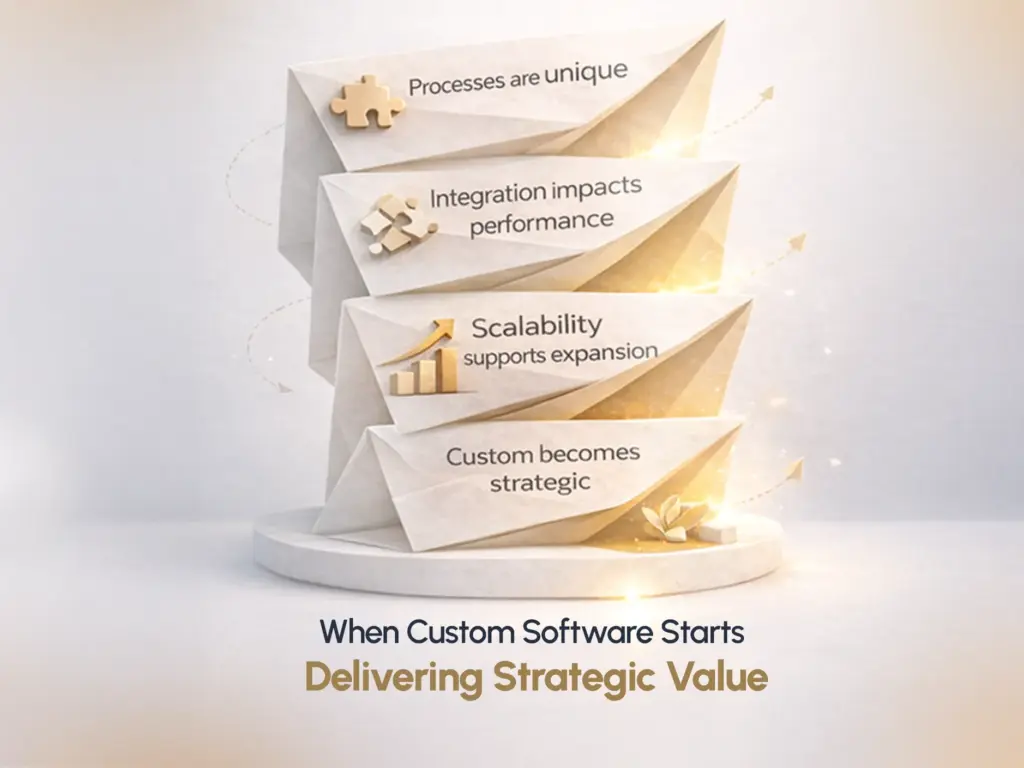
When Custom Software Starts Delivering Strategic Value
Custom solutions become strategic when processes are unique, integration affects output, automation raises margins, or scalability supports the company’s growth goals.
In these environments, tailored systems function as operational infrastructure rather than optional enhancement
IPS Approach to Custom Software Development
IPS uses a structured discovery approach for custom software projects. They analyse workflows, data connections, integration dependencies, and growth plans before deciding on the architecture.
This method aligns technology with real operations and long‑term strategy rather than short‑term issues.
Further details can be found in our sections discussing custom software development (Internal Link ) and Software Development Services (Internal Link)
FAQs
Amongst the two approaches, how can businesses choose between them?
The choice in between the two, should be based on assessing their process complexity, integration needs, scalability plans, compliance requirements, and the strategic role technology plays in their business.
How much time do custom software development services take?
Timelines vary based on scope and complexity. Enterprise systems typically follow phased implementation.
Does custom software have a higher starting cost?
It does, but over time it can reduce other expenses, especially those related to integrations and growth.

Keyur Patel
Co-Founder
Keyur Patel is the director at IT Path Solutions, where he helps businesses develop scalable applications. With his extensive experience and visionary approach, he leads the team to create futuristic solutions. Keyur Patel has exceptional leadership skills and technical expertise in Node.js, .Net, React.js, AI/ML, and PHP frameworks. His dedication to driving digital transformation makes him an invaluable asset to the company.
Related Blog Posts
TypeScript 7.0 Migration Guide: What Changed, What Can Break, and Should You Upgrade?
How We Built a Fully Offline GDPR-Compliant Transcription System